Why does my loft conversion get so hot? Ask the dishwasher
Why do loft conversions overheat in summer? The answer lies in thermal mass. A dishwasher’s drying cycle offers an unlikely route into the physics of lightweight extensions, explaining why top-floor rooms in London terraces heat up fast and prove difficult to cool.
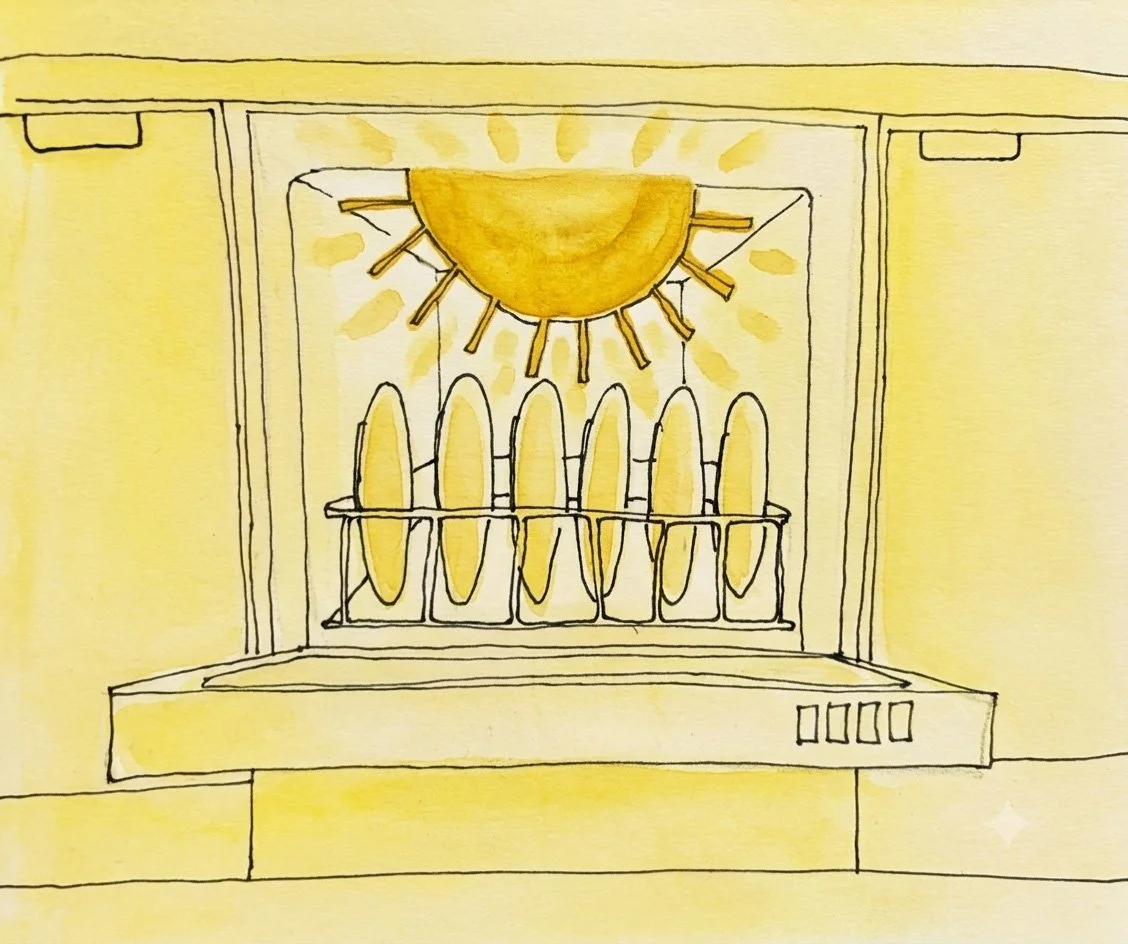
Being a dad of two, I spend a lot of time loading and unloading the dishwasher at home. In fact, it is usually the first thing I do in the morning and the last thing at night.
The dishwasher is usually brimming with ceramic plates and bowls, as well as the brightly coloured plastic crockery used by my children. Anyone who is as obsessed with the dishwasher as I am will notice a consistent phenomenon: the ceramic plates are reliably dry when the cycle completes, but the plastic plates are generally left soaking wet.
So why does plastic stay wet in the dishwasher, while ceramic comes out dry? And what does that have to do with a hot house, a London terrace, or an overheating loft conversion? The answer lies in how physical materials store and release energy - specifically, a principle in buildings known as thermal mass.
Why plastic stays wet in the dishwasher
Every material has an intrinsic property called specific heat capacity, which describes how much energy is needed to raise the temperature of one kilogram of that substance by one degree Celsius. But in the real world, the actual weight of the object matters just as much. During a wash cycle, both the ceramic and plastic plates heat up to match the temperature of the water. However, a dense ceramic dinner plate weighs significantly more than a thin plastic one. Because of its sheer mass, the ceramic plate acts like a thermal battery, absorbing and storing hundreds of joules of heat energy. The lightweight plastic plate simply doesn't have the mass to hold much energy at all.
When the cycle ends and the plates begin to cool to the ambient temperature of the room, both need to shed water. The 'superpowered' ceramic plate has oodles of stored thermal energy left to transfer into the residual water, rapidly evaporating it. The plastic plate, having stored very little energy, simply cools down and stays wet.
What thermal mass means in a house
We can extend this dishwasher metaphor directly to a typical London terraced house. Think of the original brick walls as the thermally massive ceramic plate, and a modern, lightweight loft conversion (or garden room) as the thermally light plastic plate. The heavy brick walls absorb ambient heat, maintaining a much more stable internal environment. Conversely, the lightweight timber construction holds very little energy, meaning its internal temperature fluctuates rapidly with the weather outside.
In winter, a low-thermal-mass loft will get cold the moment the temperature plunges outside - though you can quickly warm the air back up with a radiator. In summer, however, the room will overheat just as fast when the sun beats down, leaving you entirely reliant on energy-intensive air conditioning to actively cool the space.
Why heavy materials are hard to use in lofts
You might think the solution is simple: just use thermally massive materials for loft conversions and the problem is solved! Unfortunately, physics and planning laws get in the way. High thermal mass usually equates to high physical mass. Adding tons of dense masonry to the top of an existing structure can easily overwhelm the original walls.
Under UK Permitted Development rules, the walls of a loft conversion often cannot sit directly on top of the existing exterior walls; they typically require a 20cm setback from the existing eaves. This means that the new walls cannot be supported by the existing masonry, and steelwork is required to span off the walls instead. To keep those steel beams a manageable size, the new walls must be as light as possible, which heavily incentivises lightweight timber frames.
Do our houses need thermal hats?
Perhaps the future of UK retrofitting will require us to engineer thermally massive hats for our building stock. But until we solve the weight issue, we are stuck building flimsy baseball caps when what our houses really need are enormous sombreros.