Mike Tuck Studio’s Merriman Road project has been featured in The Architects’ Journal as part of its “In practice” series, with Mike Tuck and Ellen Peirson looking at the studio’s experience of using reclaimed steel beams on a domestic extension project.
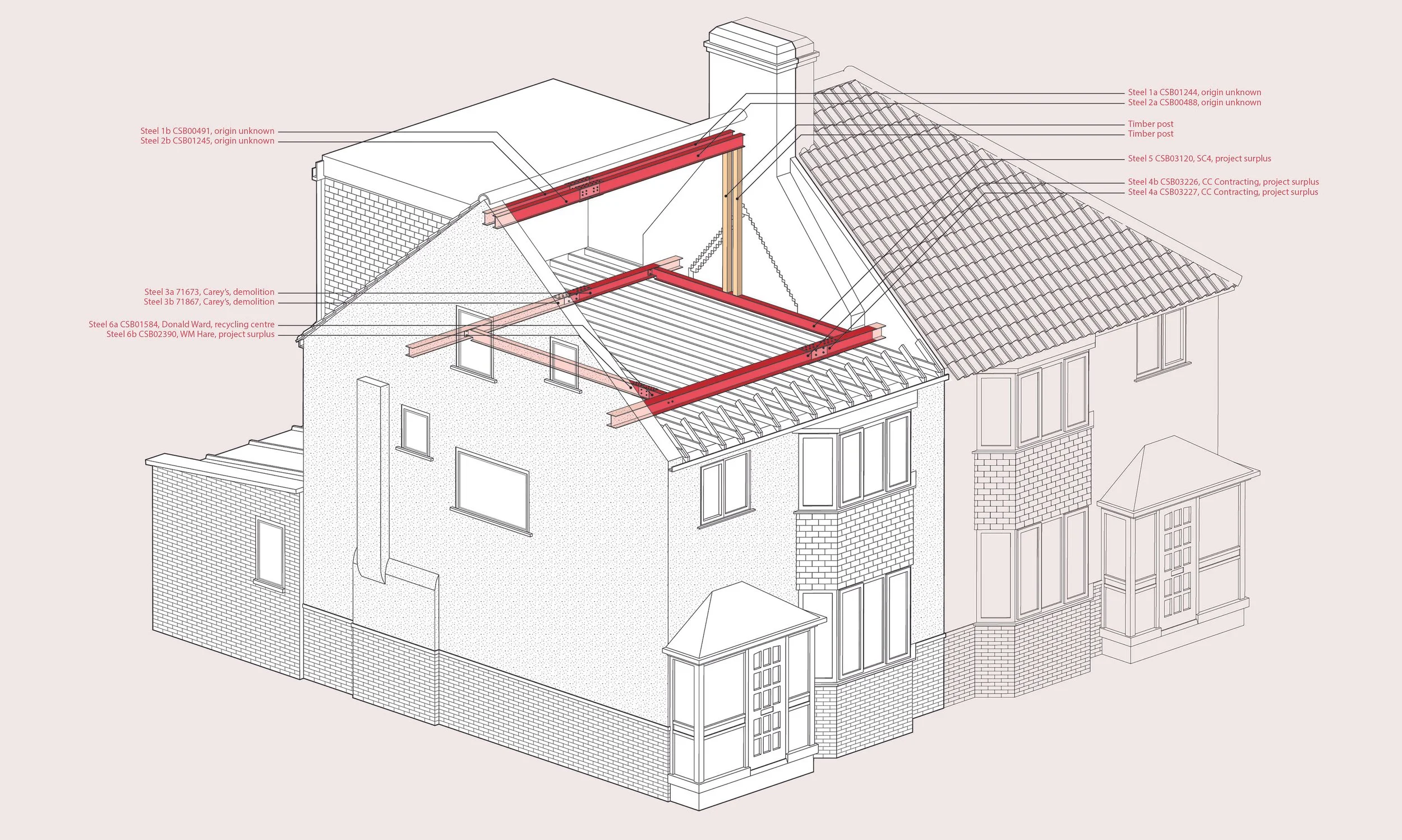
“ ‘Under the climate emergency, every household needs to be considering how we reduce waste and build for the long term,’ says Thammy Evans, a client of our practice, Mike Tuck Studio, on a deep retrofit project in Greenwich, south-east London. The Merriman Road project, currently on site, will see a post-war semi-detached house decarbonised through external and internal natural wood fibre insulation, breathable lime plaster internally, lime render externally, an air source heat pump, PV panels and wood wool board instead of plasterboard. The existing PVC windows and single-storey extension are being retained, since, though less desirable, they’re still fully functional, and the carbon emitted in creating them is already locked into the house. This rigorous preservation of existing fabric has been pushed to its limits: rather than chasing services through the wall and disturbing existing wallpaper and wall build-up, they’re being boxed out with reclaimed materials. The aim is not to impact the planet and its resources. Existing building fabric is being retained and any new materials introduced are either natural or reclaimed.”
The piece also reflects on construction’s reliance on new steel, the practicalities of reuse on a small residential project, and the role of reclaimed materials in lowering embodied carbon.
“Our landscapes are increasingly littered with the carbon-heavy mistakes of irresponsible specification. The materials we specify as an industry reflect the priorities, values and future we envision and poor choices in the methods and systems giving physical form to our ideas can lock buildings into cycles of waste and inefficiency. These past mistakes, as they are deconstructed, are mines for new opportunities. Cleveland Steel’s Yorkshire site spreads across 100 acres of semi-industrial land, where they hold as much as 84,000 tonnes of steel at any one time. This immense space is the new Port Talbot, in that it can fuel construction, but it is also full of the remains of bad constructional mistakes. Cleveland Steel’s stock is fed from both surplus steel coming from current production – so not to be considered reclaimed – and steel products being re-used mere decades after being produced. An architecture only fed by others’ carbon-heavy mistakes is not an ecological one.”
Read Ellen and Mike’s full article in The Architect’s Journal