Embodied carbon is hidden in every brick, beam, window and floorboard. Before you plan a home renovation, extension or retrofit, here’s how to understand the carbon already locked into your house, and why keeping what exists is often the lowest-carbon choice.
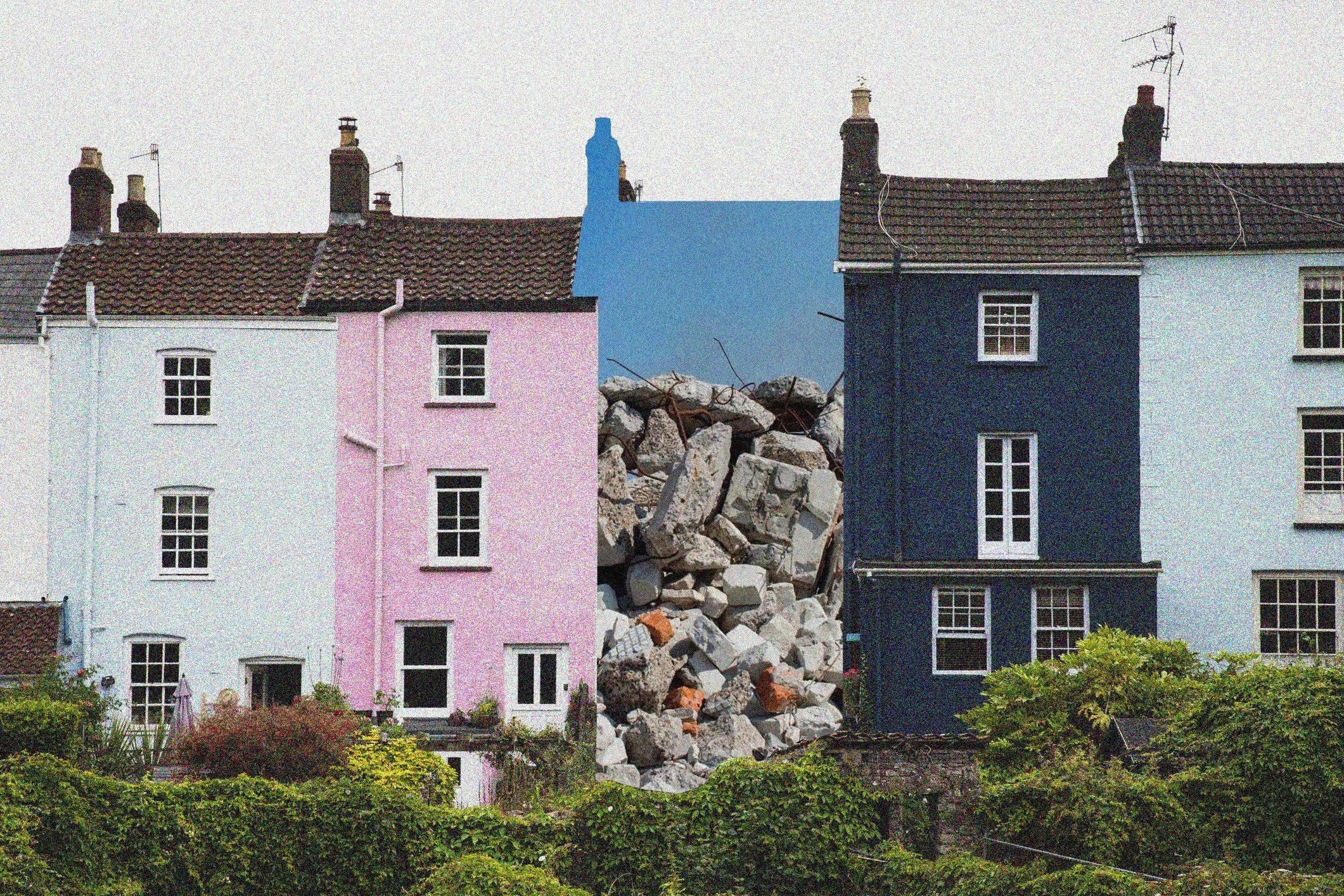
Careful: your house is full of carbon.
That carbon is in the brick walls, the roof tiles, the foundations, the windows, the floor structure, the plasterboard, the old timber joists hidden above your ceiling. Some of it was emitted when those materials were extracted, transported, fired, cast, rolled, cut, delivered and assembled. It sits there as spent carbon, already paid for by the atmosphere, already locked into the fabric of the house.
Much of the carbon content of your home is already in it - your job is to keep it there, and make sure anything you are adding is reclaimed or plant-based.
We tend to think of home improvement as a process of stripping back. Walls are knocked down to make open-plan kitchens. Floors are ripped up. Windows are replaced because they are unfashionable. Kitchens are thrown into skips before they have stopped working. The old house is treated as a problem to be corrected by new products, new finishes and new surfaces.
A typical ground-floor side-return extension contains around 2,268kg of CO₂ in its concrete foundations and slab, over 1,000kg in its brick and blockwork, almost 900kg in associated steel posts and lintels, and over 800kg in new aluminium windows and doors. Once services, finishes and roofing are included, that small extension amounts to roughly 8,900kg of CO₂, before the kitchen has even been fitted. A loft conversion can add another 6,000kg. Together, that is around 14,900kgCO₂e.
For scale, the Institute for Global Environmental Strategies suggests that a reasonable 1.5-degree lifestyle comes with an annual carbon budget of 2,500kg of CO₂ per person. A side-return extension alone can be more than three times that budget. Add a loft and the figure becomes closer to six years’ worth. By comparison, a ground-floor and loft extension at 14,900kgCO₂e with a return flight from London to New York at 1,180kgCO₂e, a year’s worth of meat consumption at 790kgCO₂e, the yearly use of an average UK car at 1,393kgCO₂e, and a new iPhone 16 Plus at 74kgCO₂e.
This does not mean that houses should be left cold, damp or uncomfortable. Many UK homes urgently need repair, insulation and better energy performance. The question is how this work is done. Thermal retrofit also needs decarbonising. Wrapping a house in plastic-based insulation, pouring unnecessary concrete, inserting steel where existing masonry could have been retained, and replacing usable materials with new ones only shifts the problem from energy bills to embodied carbon.
What carbon has already been spent, and therefore should stay in the house?
These materials have already locked in carbon during their production. When they are still functional, it is important to preserve and maintain them to avoid generating new emissions.
Existing roof tiles are typically made from concrete, clay, natural slate, or man-made slate. Roof extensions can look to reuse the tiles that will be removed to create a new opening as hanging tiles facade treatment to the dormer walls. There are frequently active and logical circular economies existing around roof tiles, with many looking to replace broken tiles with ones that match there existing tiles.
Party walls are integral to the structure of terraced houses and cannot be demolished – the carbon stays!
In many older London terraced houses, PVC windows might have replaced the original timber frames. While timber or aluminium windows may be more aesthetically pleasing, the PVC already represents locked-in carbon. Replacing functional PVC windows prematurely releases this embodied carbon into the atmosphere.
The heavy brick flank walls of the main house and outrigger embody a significant amount of carbon due to their material mass. Any structural modifications, such as creating new openings on the ground floor, require additional carbon-intensive elements like steel beams and lintels.
The original foundations of a London terraced house were designed for the load of the existing structure. Adding extensions or extra floors increases the load, often necessitating underpinning or foundation reinforcement. These processes use carbon-heavy materials like concrete and steel. To mitigate this, try to work within the limits and logic of the existing foundations, and only resort to underpinning when structurally essential.
What carbon am I adding?
You will be adding a lot of material to your home as you refurbish and extend it, as well as making decisions on the layout of your house that have carbon-heavy structural implications.
Dormer extensions involve superstructure but no substructure, making them intuitively less carbon intensive than ground floor extensions. The superstructure will be where the bulk of the carbon is, and therefore this should be carefully considered.
Selected low-carbon, natural materials for the dormer walls that minimise emissions and offer energy efficiency. Under permitted development, there is little scope for creativity in facade treatments, but if the council mandate slate, you can ensure it is natural slate instead of man-made. Natural insulations like woodfibre and hempcrete are amazing – they are carbon sinks, capturing emissions from the atmosphere, but they are also hygroscopic, meaning that they have better thermal properties than a PIR insulation of the same U-value (measure of thermal transmittance) due to their ability to draw in moisture from the environment. They will reduced the embodied carbon of your extension, keep you warm, and give you a much healthier air quality.
You will need new windows for your extension, but consider tapping into circular economies from larger scale construction through initiatives such as Green Windows, who sell on windows that were either mismeasured or surplus to requirements on large developments. These are often one offs so must be bought/reserved at the planning stage and designed around.
A side return extension can create a wide open plan space but also requires a huge amount of structure. How open plan does your space really need to be, and is it worth the carbon?
Wrap-around extensions open two sides of a structure, supporting the corner of your house with a complicated grid of steel. Is this necessary to you, or can you extend to the side and out to the back, while maintaining a lot of the brick walls, and only using shorter lintels instead? Smaller openings require much less carbon in order to span.
Underpinning may be necessary to support the increased load ont the foundations of your house. Also, if there are existing trees with deep roots near the proposed extension, then you may require deeper foundations. Work with the existing trees to avoid felling or moving them.
For a built example of this approach, see A Mended House in Stoke Newington, where Mike Tuck Studio extended and repaired a London home without using any steel.